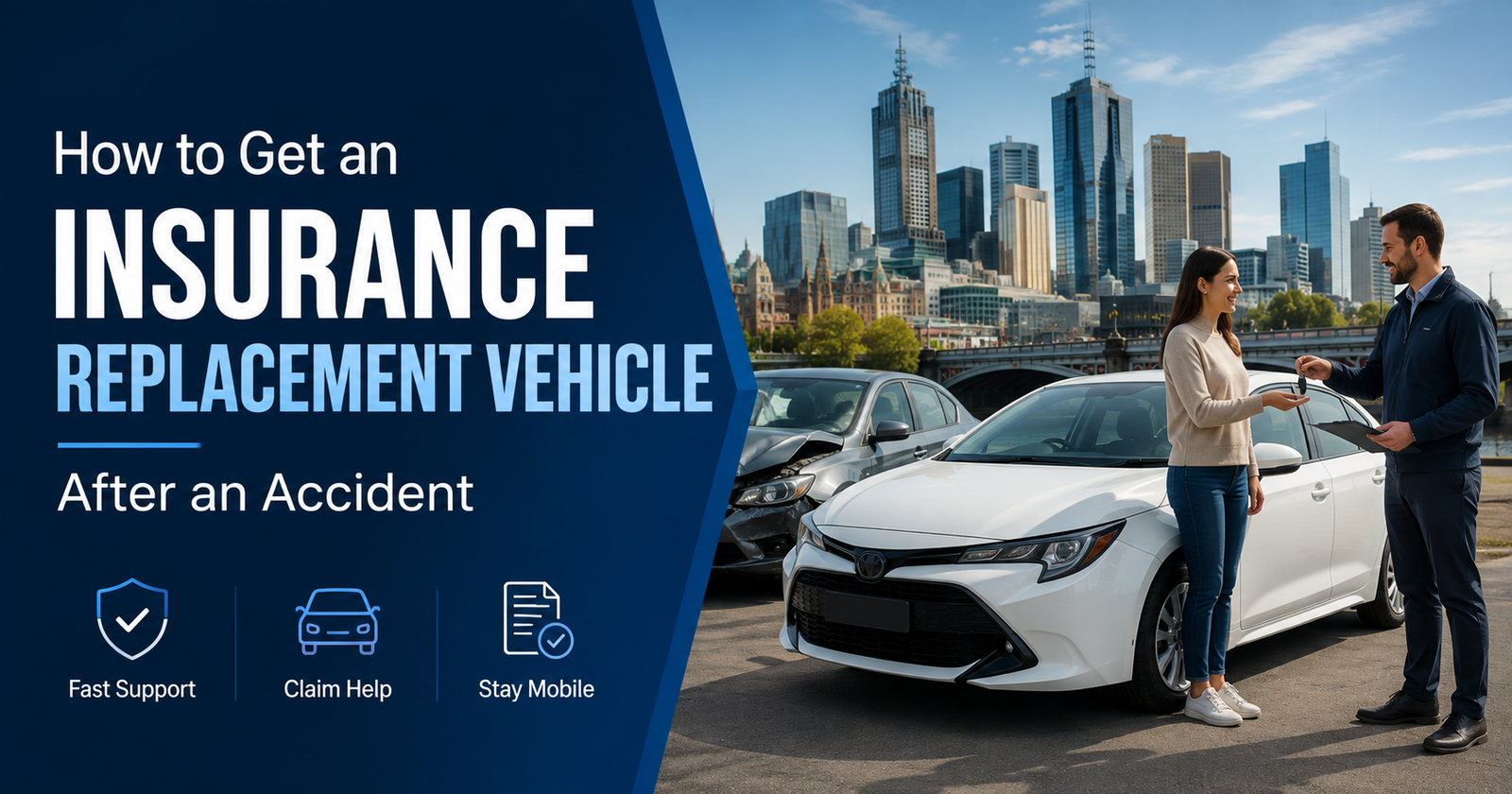
How to Get an Insurance Replacement Vehicle After an Accident
An insurance replacement vehicle may help you stay mobile while your damaged car is assessed or repaired. Learn what information to collect, what your policy may cover and how to arrange temporary transport.
A car accident can leave you without reliable transport while your vehicle is being assessed, repaired or reviewed as a potential total loss.
During that period, you may still need to commute, manage family responsibilities, attend appointments or operate your business. An insurance replacement vehicle can provide temporary transport, but the arrangement will depend on your policy, claim status, liability and approval requirements.
Here is a practical guide to arranging an insurance replacement vehicle in Melbourne.
1. Make Sure Everyone Is Safe
Immediately after an accident, your first priority should be safety.
Move away from traffic when it is safe to do so. Contact emergency services when someone is injured, the road is blocked or the situation presents an immediate danger.
Do not drive a vehicle that appears unsafe. Arrange towing where necessary.
Avoid admitting fault at the scene. Give accurate information to the police, insurer and other parties, but allow liability to be assessed using the available evidence.
2. Collect the Relevant Accident Information
Collect as much information as possible without putting yourself or others at risk.
Useful details include:
Date and time of the accident
Exact location
Other driver’s name
Other driver’s address
Phone number
Driver license details
Vehicle registration
Insurance company
Policy or claim information
Witness contact details
Police event or report number
Photographs of vehicle damage
Photographs of the accident location
Towing details
Repairer information
Do not rely only on a verbal exchange. Photograph relevant documents and vehicle registrations when permitted.
Accurate information can help your insurer assess the incident and may also be required before a replacement-vehicle arrangement can be approved.
3. Contact Your Insurer Promptly
Notify your insurer as soon as reasonably possible.
Explain what happened and provide the available evidence. Ask for a claim number and keep it somewhere accessible.
Money-Smart’s official guide to claiming on your car insurance recommends checking what your policy covers and following the insurer’s claim process.
Ask your insurer:
Has the claim been lodged successfully?
Is my vehicle approved for assessment or repairs?
Does my policy include hire-car cover?
When does hire-car eligibility begin?
How long does the benefit continue?
Is there a daily cost limit?
Do I need to use an approved provider?
Is insurer approval required before booking?
Will I have to pay the rental cost first?
What happens if repairs are delayed?
Request written confirmation wherever possible.
4. Check Your Policy’s Replacement-Vehicle Cover
A replacement vehicle is not automatically included in every motor insurance policy.
Cover may apply:
After theft
Following an insured accident
When the insured driver is not at fault
While approved repairs are completed
For a maximum number of days
Up to a specified daily rental amount
Only when hire-car cover was selected as an optional benefit
Read your Product Disclosure Statement and Certificate of Insurance.
Pay attention to exclusions, waiting periods, daily limits, vehicle categories and the circumstances in which the benefit ends. For example, hire-car cover may stop when repairs are completed, a total-loss settlement is offered or the maximum approved period expires.
The Insurance Council of Australia provides a general guide to car insurance claims explaining important steps in the claims process.
5. Understand Not-at-Fault Replacement-Vehicle Arrangements
When another driver is responsible for an accident, you may be approached by a credit-hire or accident-management provider offering a replacement vehicle.
Under some arrangements, the provider supplies a vehicle and later attempts to recover the rental cost from the at-fault driver or their insurer.
Do not assume this means the vehicle is automatically free or that you have no financial responsibility.
Before signing, ask:
Who is responsible for the rental charges?
What happens if liability is disputed?
What happens if the other insurer refuses payment?
Am I responsible for assisting with cost recovery?
Could I be asked to provide evidence or attend court?
Is there a daily rental rate?
Is the replacement vehicle reasonably comparable?
What happens if I keep the vehicle longer than necessary?
What damage excess applies?
Are there kilometer limits?
What documents am I signing?
Read the full agreement and obtain independent advice where the financial or legal obligations are unclear.
6. Contact the Replacement-Vehicle Provider
Once you understand your claim position, contact a suitable rental or replacement-vehicle provider.
Melbourne Easy Rental assists customers with insurance replacement vehicle enquiries after eligible accidents and insurance claims.
You may need to provide:
Claim number
Insurer details
Accident information
Repairer details
Expected repair period
Driver license
Contact information
Preferred pickup location
Required vehicle type
Approval confirmation
Melbourne Easy Rental provides pickup options in Mulgrave and Truganina, subject to the confirmed arrangement.
7. Choose a Suitable Vehicle
The temporary vehicle should meet your reasonable transport requirements.
Discuss whether you need:
A standard passenger car
An SUV for family transport
A vehicle with sufficient luggage space
A premium vehicle
A commercial van
A vehicle for business travel
Space for child restraints
Accessibility-related features
The replacement vehicle may not be the same make or model as your damaged vehicle. Confirm the seating, luggage space, transmission and other important specifications before collection.
View the current Melbourne rental vehicle range and ask the team to confirm what is available for your dates.
8. Review the Rental Conditions
Even when the rental is connected to an insurance claim, you will normally have a separate vehicle rental agreement.
Review:
Rental period
Daily rate
Approved payment arrangement
Security deposit
Damage excess
Kilometer allowance
Fuel policy
Additional-driver conditions
Toll charges
Traffic infringements
Cleaning charges
Extension procedure
Breakdown assistance
Accident-reporting process
Return conditions
Do not collect the vehicle until you understand which expenses are covered and which remain your responsibility.
9. Keep Records Throughout the Claim
Keep copies of:
Claim correspondence
Insurer approvals
Repair estimates
Rental agreement
Vehicle-condition report
Photographs
Rental invoices
Fuel receipts
Towing invoices
Repair updates
Return confirmation
Record the name of each person you speak with, the date of the conversation and what was agreed.
Good records can be particularly important when there is a disagreement about rental periods, liability, repair delays or payment responsibility.
10. Return the Vehicle When Approval Ends
Stay in contact with your insurer, repairer and rental provider.
Confirm the approved return date when:
Your vehicle repairs are completed
Your vehicle is declared a total loss
Your claim is settled
Your insurer’s hire-car benefit ends
The provider asks you to return the vehicle
Do not assume an extension has been approved. Obtain confirmation before keeping the vehicle beyond the original rental period.
What If You Have an Insurance Dispute?
Start by raising the issue directly through your insurer’s internal dispute-resolution process.
Explain the problem clearly and provide supporting documents. Ask the insurer to respond in writing.
When the dispute cannot be resolved directly, eligible consumers may be able to make a complaint to the Australian Financial Complaints Authority. AFCA provides a free and independent dispute-resolution service and publishes information about insurance complaints.
Arrange Temporary Transport After an Accident
An insurance replacement vehicle can reduce disruption while your car is being assessed or repaired. However, you should confirm your policy cover, claim approval, rental obligations and return conditions before accepting a vehicle.
Melbourne Easy Rental supports replacement-vehicle enquiries for eligible accident and insurance-claim situations across Melbourne, Mulgrave and Truganina.
Discuss your insurance replacement vehicle or contact Melbourne Easy Rental with your claim details and transport requirements.
Insurance approval, liability, pricing, vehicle availability and rental duration depend on the individual claim and agreement. This article provides general information and is not legal or financial advice.